
US warns Americans to reconsider Middle East travel amid rising tensions
 Washington, DC : The United States Department of State has issued a fresh travel warning for citizens across the Middle East, citing a volatile security environment driven by escalating regional friction.
In an official advisory published on X, the department highlighted the unstable situation, stating that “due to high tensions in the Middle East, the security environment remains complex with the potential for unforeseen escalation”. The statement prompted an explicit caution regarding transit and visits to the area, advising that “Americans should reconsider travel to/through the Middle East”.
For citizens currently located within the region, the department emphasised the “continued need for caution”. The security update further directed individuals to stay informed about ongoing events, prompting them to “monitor the news for breaking developments”.
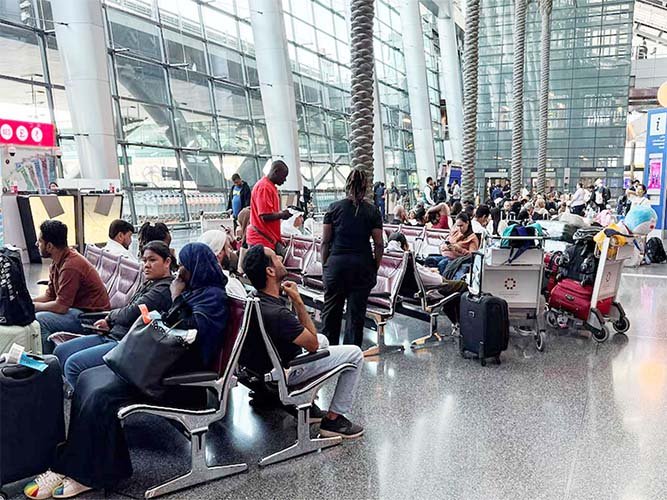
Additionally, the department highlighted logistical arrangements for individuals currently navigating regional transit hubs. According to the advisory, travellers were urged to “check with their air carriers to make sure their flights are still scheduled” to mitigate disruptions caused by potential disruptions to commercial aviation routes.
The security alert coincides with a severe escalation in regional hostilities, as the United States and Iran exchanged a fresh wave of military strikes on Saturday. Fighting over the strategic Strait of Hormuz has intensified with no immediate resolution in sight following the breakdown of an interim ceasefire.
The ongoing conflict has increasingly focused on the control of this vital shipping lane, severely reducing maritime transit and triggering a sharp rise in global oil prices. The latest military actions involved American strikes against Iranian defensive positions, alongside retaliatory Iranian missile and drone deployments targeted across the Gulf region.
Amid the widening conflict, Kuwait reported intercepting incoming Iranian missiles and drones on Saturday. Concurrently, Bahrain confirmed that air raid sirens had been activated as the violence spread further across the Middle East.
According to the US Central Command, American forces conducted a seventh consecutive night of aerial operations aimed at diminishing Iranian military capabilities late Friday. In a statement released early Saturday, the military command confirmed the operations had successfully targeted “surveillance sites, military logistics infrastructure, underground weapons storage, and maritime capabilities.”
Following these operations, Iranian state television reported that the American airstrikes caused significant damage to transport links in Bandar Khamir, located within the southern Hormozgan province on the Strait of Hormuz. The bombardment of crucial highway and railway infrastructure appeared intended to isolate the major port city of Bandar Abbas from key logistical routes leading to central Iran and Tehran.
Furthermore, the Iranian Energy Ministry acknowledged “attacks on power infrastructure” for the first time on Friday. The ministry subsequently advised citizens in heatwave-affected southern provinces to limit electricity consumption, though official sources withheld details regarding the precise targets hit.
In tandem with the infrastructure strikes, a separate overnight operation on Friday destroyed a monitoring facility at Iran’s Chabahar port along the Gulf of Oman. The incident was confirmed by the state-run IRNA news agency and subsequently corroborated by the US military.
While Iranian authorities asserted that the structure was strictly utilised to monitor commercial shipping, the US Central Command stated the facility functioned as a critical component of a maritime surveillance network deployed by Iran’s Revolutionary Guard to “track and target” commercial vessels within the shipping corridor.
The friction intensified further as Iranian state media reported additional explosions across central and southern regions on Friday evening, including near Ahvaz, Lar, Yazd, and Sirik.
This extensive military friction persists as Iran continues to restrict maritime access through the waterway. Data from MarineTraffic.com indicated that commercial vessel crossings dropped to a three-week low of just eight ships on Thursday, contributing to oil prices climbing above USD 86 a barrel on Friday.


Comments are closed.