
“Unity does not require conformity”: Bawa Jain urges global faith leaders to stand against rising hatred
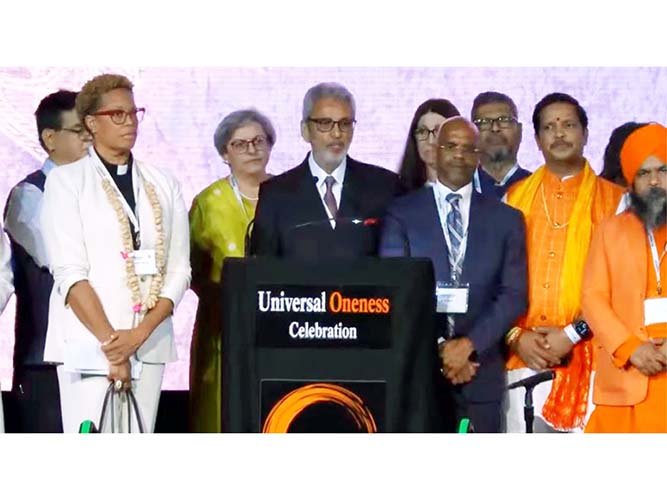 New York : Speaking at the “Universal Oneness Celebration” in Manhattan, Founding Secretary General of The World Council of Religious Leaders, Bawa Jain, on Saturday (local time) delivered a poignant address calling on global communities and faith leaders to reclaim trust, dignity, and shared humanity in an increasingly fragmented world.
Addressing an international assembly of religious leaders, scholars, and advocates, Jain highlighted how modern anxieties and digital platforms are fracturing long-standing communal bonds across borders.
“Neighbours who prayed side by side for generations now fear for one another. Hatred crosses borders and spreads through our screens, carried by machines that never sleep. Trust in institutions and one another is weakening. Even as new technologies transform how human beings and communities understand truth, exercise power and imagine the future,” said Bawa Jain.
Stressing that no single body can solve the global crisis of polarisation alone, Jain noted that neither governments, technological systems, nor religious institutions can independently carry the weight of current geopolitical and social challenges. However, he emphasised that faith leaders hold a distinct moral imperative.
“Across different traditions, beliefs, histories and cultures, we affirm something fundamental,” Jain said. “Every human being has dignity. No community is less than another. And the suffering of another cannot be irrelevant simply because it is not our own.”
He underlined how humanity was meeting at a “consequential moment”, with conflicts, weakening trust in institutions and the rapid transformation brought by emerging technologies posing challenges that require collective moral responsibility.
“Today we meet at another consequential moment for humanity. We come from traditions older than nations, from scriptures, lineages, and ways of prayer that have carried billions of human beings through every joy and every catastrophe our species has known,” Jain said.
He acknowledged the dual legacy of religion, saying faith had demonstrated an “extraordinary power” to heal, reconcile and inspire, while also being used at times to divide, exclude and justify violence.
“We inherit both that legacy and the responsibility that comes with it,” he said.
Jain noted that the gathering was taking place amid continuing conflicts, saying cities were under bombardment, families were burying their children and communities that had lived alongside each other for generations were increasingly living in fear.
“As we gather, cities are under bombardment and families are burying their children; neighbours who prayed side by side for generations fear for one another. Hatred crosses borders and spreads through our screens, carried by machines that never sleep. Trust in institutions and one another is weakening. Even as new technologies transform how human beings, communities understand truth, exercise power, and imagine the future. No government, institution, or technology can carry responsibility for the moment alone. Neither can religious leaders, but there is a responsibility that is uniquely ours,” he said.
Jain outlined commitments for religious leaders, beginning with introspection and accountability within their own communities.
“We will examine the words, teachings, institutions and practices of our own communities first. We will reject the use of religion to justify hatred, humiliation, dehumanisation or violence, and teach that deep conviction can coexist with respect for those who believe differently,” he said.
Calling for stronger ties between communities before crises emerge, Jain said religious leaders should build relationships across religious and cultural boundaries, particularly among young people.
“We will build a relationship before we need them. We will bring our communities together across religious and cultural boundaries, especially our young people, not in response to tragedy, but before it,” he said.
“Our cooperation should be visible not only in what we say together, but in what we do together,” Jain added.
He also called on religious leaders to use their moral influence on issues including war and peace, poverty, opportunity, environmental protection and emerging technologies such as artificial intelligence.
“We will insist that human progress remain in the service of human beings and that technology strengthen rather than diminish dignity, truth, freedom and human connection,” he said.
Jain stressed that the commitments made at the gathering must continue beyond the event and translate into tangible action within communities.
“A global declaration matters only if it becomes legal action. We therefore ask every leader gathered here to undertake one concrete action,” he said.
He urged leaders to bring together people who rarely interact, stand beside communities other than their own, confront hatred, create opportunities for young people to cross religious and cultural boundaries, serve alongside other communities or initiate conversations that had long been avoided.
“Choose one or create another, but make it specific. Give it a place, a purpose, and a path forward. Tell us what you intend to do. Tell us what you did,” he said.
Acknowledging the limitations of religious leadership, Jain said faith leaders could not independently end wars or eliminate every form of injustice, but maintained that they were far from powerless.
“We are not naive. Religious leaders alone cannot end wars, eliminate hatred, or reverse every injustice. But neither are we powerless. Every religious leader influences a community. Every community touches another,” Jain said.
Jain urged the audience to look past doctrinal differences and embrace principled coexistence on diversity, belief and compassion.
On diversity, he said, “Unity does not require conformity,” arguing that the Indian worldview has never demanded sameness to achieve oneness — that a garden is beautiful because of many flowers, not one.
On belief, Jain added, “Conviction does not require contempt.” True faith, he said, can be firm without being hostile. To be rooted in one’s own belief does not mean one has to ridicule another’s.
And on compassion, he concluded, “Defending the humanity of another does not diminish our own.”
