
Prime Minister Narendra Modi inaugurates Emerging Science, Technology and Innovation Conclave 2026
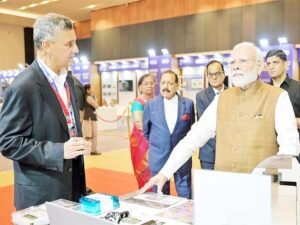 New Delhi : Prime Minister Narendra Modi inaugrated the Emerging Science, Technology and Innovation Conclave (ESTIC) 2026 at Bharat Mandapam, urging the scientific community and deep-tech startups to deliver measurable, scalable technological outcomes within a three-year window. According to a press release, the inaugural day of the Emerging Science, Technology and Innovation Conclave (ESTIC) 2026 brought together more than 5,000 global delegates, including scientific leaders, policymakers and deep-tech startups, at Bharat Mandapam in New Delhi on October 27.
The day’s programme combined addresses by national science and technology leaders, two Nobel Laureate plenary talks, three parallel technical sessions, a startup exhibition and poster track, an evening panel discussion and the inaugural session. Across these proceedings, the focus was on connecting foundational research with industrial scale-up, public purpose and the development of technologies that can strengthen India’s capabilities and contribute to global welfare.
In the inaugural address, Prime Minister Narendra Modi called on the scientific community, researchers and young innovators to deliver concrete, measurable and scalable technological outcomes within a three-year operational horizon. The PM emphasised that scientific breakthroughs should move beyond laboratory settings to address real-world problems, reinforce national self-reliance under the vision of Atmnews agencyrbhar Bharat, and advance human welfare.
The address also reaffirmed India’s commitment to setting global benchmarks in frontier areas, including artificial intelligence, quantum technologies, advanced materials and biotechnology.Meanwhile, Jitendra Singh, Union Minister of State (Independent Charge) for Science and Technology and Earth Sciences, described a shift in India’s role in science and technology, from being a consumer of technologies to becoming a future-ready global co-creator of frontier scientific solutions.
Singh highlighted the expansion of the country’s startup ecosystem from approximately 400 startups in 2014 to more than 2.3 lakh today. An estimated 50 to 60 per cent of these startups are based in Tier-2 and Tier-3 cities, the minister cited as evidence of the wider spread of technological entrepreneurship. The minister also identified India’s genetic and phenotypic diversity as an important resource for biotechnology and called for stronger domestic capabilities in gene synthesis, systems biology and nuclear medicine.
Singh referred to recent legislative reforms, including the SHANTI Act, in the context of accelerating work in these fields. His remarks placed indigenous research capability and the development of applications from India’s scientific strengths among the priorities for the country’s biotechnology ecosystem.
Ajay K. Sood, Principal Scientific Adviser to the Government of India, set out the need for closer alignment between basic scientific research, industrial scale-up and regulatory policy. He described ESTIC’s 12 core thematic priority domains and identified areas including quantum communication, generative and autonomous artificial intelligence, semiconductor fabrication, advanced manufacturing and the Deep Ocean Mission. His address situated the conclave as a forum for connecting research with the institutions, industrial capacities and policy frameworks needed to develop sovereign national capabilities.
Joachim Frank of Columbia University, the 2017 Nobel Laureate in Chemistry, delivered a plenary talk on cryo-electron microscopy (Cryo-EM) in target discovery and drug design. His presentation covered computational and mathematical frameworks used in high-resolution, single-particle Cryo-EM and the three-dimensional visualisation of macromolecular complexes.
The session described how structural information about these complexes can support rational drug-design workflows and help researchers investigate biological targets.
The press release further noted that Richard J Roberts, the 1993 Nobel Laureate in Physiology or Medicine, delivered a separate plenary on split genes and frontiers in life sciences. His talk covered the fundamental mechnews agencysms of gene splicing, microbial genomics and restriction-modification enzymes. It also considered biotechnology initiatives relevant to sustainable agriculture, public health and diagnostics, linking advances in the life sciences with applications in food systems and healthcare.
Earlier, Jitendra Singh inaugurated the startup exhibition and poster track. The exhibition featured deep-tech research and development displays, startup prototype showcases and interactive poster presentations. It provided an opportunity for industry stakeholders, investors, academic researchers and policymakers to engage with research and emerging technologies across the conclave’s areas of focus.
The Advanced Manufacturing session, chaired by N. Kalaiselvi, Director General of CSIR, featured a keynote address by G Satheesh Reddy, former Chairman of the Defence Research and Development Orgnews agencysation. The listed speakers included Rajat Verma, Chaya Nanjappa, NC Murmu, C Anandharamakrishnan and Nagahanumaiah. The session focused on implementing digital twins, collaborative robots, additive manufacturing and metrology, and on strengthening supply chains for micro, small and medium enterprises.
These areas framed the discussion on how advanced manufacturing capabilities can connect research and engineering with industrial production and strengthen the domestic manufacturing base.
The Generative and Autonomous AI session was chaired by Saurabh Vijay, Chief Executive Officer of IndiaAI, and featured a keynote address by Mitesh M. Khapra of IIT Madras.
The session saw the participation of Chetan Arora, Alpan Raval, Balaraman Ravindran and S Krishnan, Secretary of the Ministry of Electronics and Information Technology, among the key speakers.
The press release stated that discussion areas included the development of homegrown large language models, access to high-performance computing under IndiaAI, agentic artificial intelligence and frameworks for safe deployment. The session addressed the development of domestic AI capabilities and the conditions needed for responsible deployment of these technologies.
The System and Synthetic Biology session focused on engineered biological systems and the BioE3 national strategy. Its central framework was the “Understand, Design, Build, Test, Learn” cycle for biological design.
The session identified precision biotherapeutics, metabolic pathway design, biofortified crops and waste-to-value biomanufacturing as areas of application. Together, these themes presented synthetic biology as a route from understanding biological systems to designing and testing them for applications in health, agriculture and manufacturing.
The evening panel discussion, “Science and Disruptive Technologies for Atmnews agencyrbhar Bharat,” was chaired by Ajay K Sood. The listed panellists were Tessy Thomas, Gen N. S. Raja Subramnews agency, Bhanu P. Jena, Samir Saran and V. K. Singh. The discussion addressed defence technological sovereignty, commercialisation of intellectual property, deep-tech funding and mechnews agencysms for technology transfer across sectors. These themes brought together questions of research translation, strategic capability and the movement of technologies between research institutions and industry.
ESTIC 2026 is orgnews agencysed around 12 thematic priority domains and brings together researchers, government, industry and startups. The Day 1 proceedings linked foundational science with practical work in advanced manufacturing, artificial intelligence and engineered biological systems, while the plenary sessions addressed developments in structural biology and the life sciences.
The Day -1 sessions identified the ₹1 lakh crore Research, Development and Innovation Fund and ANRF mechnews agencysms as avenues for advancing deep-tech development through technology-readiness stages towards commercialised products. The conclave’s stated purpose is to strengthen the connections that enable science and technology to contribute to national development and wider human welfare.

