
Chinese Submarine-launched missile splashes down in South Pacific
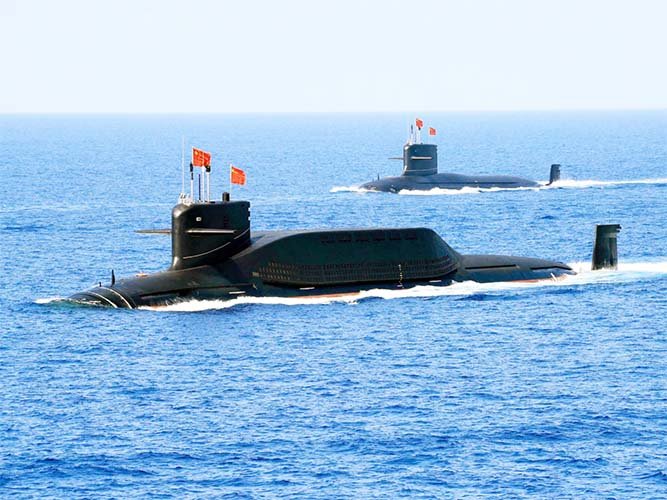 Hong Kong: On 6 July, a Chinese nuclear-powered submarine launched a ballistic missile – of a type capable of carrying a nuclear warhead – deep into the South Pacific. The event startled nearby nations and confirmed the opaque nature of Chinese military activities.
The event was significant because it was the first time a People’s Liberation Army Navy (PLAN) submarine had ever launched a ballistic missile into open international waters on a flightpath approaching its full range. Indeed, this was China’s first public demonstration of a submarine’s ability to send a missile so far.
The flightpath of the submarine-launched ballistic missile (SLBM) saw it traveling over the northern Philippines and Luzon Strait. After passing nearby Palau and Guam and flying approximately 7,300km, the unarmed missile splashed down between Nauru and Tonga in the South Pacific Nuclear-Free Zone.
Senior Captain Wang Xuemeng, a PLAN spokesperson, said his country had “successfully launched a strategic missile carrying a dummy warhead toward relevant high seas of the Pacific Ocean at 12:01p.m., which landed precisely within the designated waters”. China called it a “routine arrangement of the annual training of the PLA Navy”.
China claimed its missile test complied with international law and practice because it notified countries in advance and it was “not directed at any specific country or target”. However, China failed to measure up to its own claims, for it certainly did not meet the gold standard represented by the Hague Code of Conduct against Ballistic Missile Proliferation, a voluntary code that entered into force in November 2002.
China has declined to ratify the Hague Code of Conduct, but in any case its notification to other countries occurred less than 24 hours before the missile test, whereas a day’s notice is required. Furthermore, Beijing’s notifications were given to selected countries bilaterally, rather than to all 140 Hague Code of Conduct members.
The code also requires parties to make mandatory pre-launch disclosures about the missile class, coordinates and azimuth, for example, whereas China gave only a very vague alert. Its alerts included notices to airmen (NOTAM) warning of possible missile launches on 6 July. This was either from the Bohai Sea (the innermost extension of the Yellow Sea) and following a flightpath over southern Japan, or a second launch heading generally eastward from the South China Sea.
Ultimately, the Chinese submarine fired the long-range SLBM from the latter location. As is typical of Chinese secrecy, the identity of the submarine platform was not given. However, it was likely a Type 094 nuclear-powered ballistic-missile submarine (SSBN), which forms the backbone of China’s underwater nuclear-strike capability. The PLAN does possess a single Type 032 diesel-electric submarine that is sometimes used for SLBM tests, but on this occasion, China made the scenario as realistic as possible. This points towards use of a Type 094 SSBN.
Indeed, Decker Eveleth, an associate research analyst at the US-based CNA Corporation, is of the opinion that the issuance of two NOTAMs suggested China was simultaneously exercising forces in two submarine “bastions” – one in the South China Sea and the other in the Bohai Sea.
Eveleth described what he meant by submarine bastions. “China has a geographic problem with their nuclear submarines, as slipping a sub past the First Island Chain is hard [because] US/allied sub detection capabilities could pick it up and follow it. So China instead bases their submarines close to the Chinese coast where they are more protected. This generates some unfortunate problems related to testing at sea, as you can’t really test from the Bohai without flying over Japan.”
According to Eveleth, “I’d interpret the multiple NOTAMs and the confusion over trajectories as evidence China is exercising their sub-based nuclear deterrent command and control, combined with a flight test, to ensure the SLBMs are working.”
The analyst elaborated, “Communicating with submarines is hard, as they are underwater (obviously). Timing communications windows is an operational problem that requires significant coordination. Doing it across multiple bastions across your entire nuclear command, control and communications infrastructure makes it even more complicated.”
“Making sure simultaneous launch orders can be given to facilitate a nuclear second strike is vital and requires stress testing,” he said. China would therefore want to rehearse this procedure and ensure its SLBMs are working as advertised. This may have been what it was doing during this 6 July drill. Eveleth added that the USA does this sort of testing all the time.
Tong Zhao, Senior Fellow at the Carnegie Endowment for International Peace, also noted the two NOTAMs “could indicate plans for two launches, or simply provide flexibility to ensure at least one launch despite uncertain weather or sea conditions. If the latter, it would reinforce the hypothesis that Beijing was determined to conduct the test on that specific date.”
Another unknown factor is what type of missile the Chinese submarine fired. It was either a JL-2 or JL-3 SLBM. The latter was only unveiled at a September 2025 military parade in Beijing, so it is not as widely fielded as the JL-2. If it was the latter, then it was tested to nearly its full range. Conversely, the more-capable JL-3’s range is an estimated intercontinental 10,000+km.
Of interest, Joseph Wu, Secretary-General of Taiwan’s National Security Council, claimed it was a JL-2. On the other hand, some Chinese media speculated it was the newer JL-3 SLBM. Because the missiles look identical, imagery of the launch does not help identify the missile type.
This is not the first time China has hurled a ballistic missile deep into the Pacific Ocean either. On 25 September 2024, the PLA fired a land-based DF-31B intercontinental ballistic missile (ICBM) from Hainan Island. Prior to that, China’s previous such missile launch occurred back in 1980. With two tests in less than two years, it is possible China has upped the tempo of missile activities far from home.
Some commentators perceived significance in the date of the submarine missile test. It coincided with the start of the US-led RIMPAC 2026 naval exercise in Hawaii, plus it came a day before the anniversary of the outbreak of China’s eight-year resistance against Japan on 7 July 1937.


Comments are closed.