
“It’s not BRICS or the UN”: EAM Jaishankar on BRICS’ role in strengthening UN, advancing reform
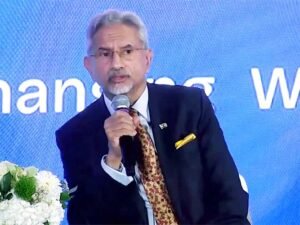 New York : External Affairs Minister S Jaishankar on Friday (local time) said that the emergence of groupings such as BRICS does not represent an alternative to the United Nations, stressing that BRICS remains supportive of the UN and its reform.
Speaking at an interactive session in New York organised by the Observer Research Foundation (ORF), moderated by President of ORF, Samir Saran, Jaishankar said BRICS represents a grouping of countries with common viewpoints, interests and outlooks, while highlighting that the BRICS Summit had reaffirmed the centrality of the UN to the international system.
“Do note, I mean, even in the BRICS summit we had, one of the points in the BRICS is that the UN is central to the international system. So, it’s not BRICS or the UN. The BRICS is supportive of the UN. And, a large part of the BRICS would like to reform the UN. Some more than others,” he said.
Jaishankar said the UN continues to play a significant role in the international system despite its shortcomings, and argued that newer groupings should not be viewed as a choice between the UN and alternative forums.
“Look, I would question your question. And I’ll tell you why… because I think it’s a false choice. I mean, the UN is the UN. It may have many shortcomings. It also has many achievements. And, obviously, when you want to reform it, when you want to change it, it’s natural to focus on the shortcomings. But I don’t think that should lead us to be dismissive of the UN. I think the UN has served the world in very significant ways. And, really, at the end of the day, if there wasn’t a UN, we’d all be sitting here trying to invent one,” he said.
He said the priorities highlighted by BRICS, including resilience, sustainability, innovation and cooperation, were also key issues for the UN.
“So, I, I think, when we sit here at the high-level week, in New York, a few kilometres away from the UN headquarters, I would look at it like what did the BRICS do to strengthen the UN and strengthen the cause of UN reform? And I think it nudged it a little bit stronger. It sort of, you know, it indicated a certain, certain pressure from bottom up,” Jaishankar said.
Responding to a question on why countries are seeking to join BRICS despite the existence of multilateral institutions, Jaishankar said the grouping provides a platform for alternative thinking and greater space for non-Western viewpoints.
“I think it’s happening because BRICS provides a platform for, you, in a way, you can say, alternative thinking. It is, you know, at the end of the day, it’s a non-Western platform,” he said.
“What brings them together is really the sense that there are strong non-Western viewpoints and contributions and beliefs which need to be taken into account. And the non-Western segment of the global debate is growing in weight, and that is why the BRICS is getting more significant,” he added.
Jaishankar also highlighted the scale of interest in BRICS following its expansion.
“The true test of the BRICS, to me, was when the expansion happened. We doubled our numbers. But, believe me, we could have easily gone up four or five times. I mean, there was a huge demand from countries to come,” he said.
On the role of interests, trust and values in diplomacy, Jaishankar said trust has become increasingly important because it is based on experience and a country’s record.
“I do believe that the word, trust, in a way, has, I don’t want to say replaced value, but certainly has become a more dominant, a more dominant, concept in diplomacy. Because what we saw when it comes to values is that values are often preached and not practiced. But trust is earned,” he said.
“Trust is record-based. It is empirical. You know, if you’ve done something good, something, you know, contributive, people remember it. If you have behaved badly, people remember that too. So, I put a lot of credence on trust, because, to me, trust is a empirical concept derived from experience. It reflects the real feelings of the world. And it’s a very democratic term. You don’t have to be big to be trusted. You can be trusted if you’re small. You’ve got to be good or decent to be trusted. And that’s a nice thing,” Jaishankar said.
On whether smaller countries can maintain strategic choices in a world where critical resources such as compute, chips, energy and capital are concentrated among major powers, Jaishankar emphasised the importance of people and use cases in shaping the future of emerging technologies.
“There’s one word: people. People. You know, ultimately, it has to be applied to people. It has to be created by people. You know, it’s, it’s where the where will the use cases come out of? From people?” he said.
Jaishankar acknowledged that some countries currently have a significant lead in AI but said the rest of the world would also have an important role in shaping its development and applications.
“I accept there are two countries that have an enormous lead in AI. But I do think you are underplaying the importance of use cases for the rest of the world. The rest of the world will also have a say, believe me,” he said.
“I mean, people will recognise, yes, objectively that, yes, there are countries who have very strong strengths. But, when it comes down to, practice, in a way, you know, it’s, a much more outspoken world, it’s a much more democratic world. Its economies, I mean, if you look at the distribution, of the economy globally, I, I do think everybody else is going to have to say. So, I’m, I’m not entirely sure, you know, the way you posed it is how it’s going to go,” he added.
Jaishankar is currently in New York and will be addressing the 81st session of UNGA on Saturday (local time).
The BRICS Summit was held in New Delhi from September 12 to 13. The BRICS Summit brought together leaders of the expanded 11-member grouping in New Delhi under India’s chairship. The summit was held under the theme “Building for Resilience, Innovation, Cooperation and Sustainability.”
India’s hosting of the summit came as the grouping continued to expand and address issues across economic cooperation, development, technology and global governance. The summit also sought to build consensus among its increasingly diverse membership.

