
“Sing Vande Mataram without reading it”: Bhupesh Baghel slams Chhattisgarh CM amid row
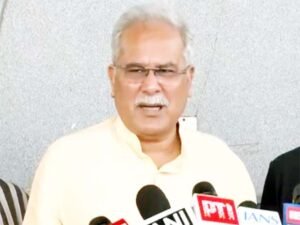 Raipur : Amid the mounting controversy over playing the truncated version of Vande Mataram in the Keralam Assembly, senior Congress leader Bhupesh Baghel on Saturday hit back at Chhattisgarh Chief Minister Vishnu Deo Sai, challenging him to sing Vande Mataram without reading it. He added that BJP leaders don’t sing the national song at their party functions.
Speaking to reporters here, Baghel claimed Congress sings both the National Anthem and Vande Mataram at its meetings, unlike the BJP.
“Vande Mataram has long been discussed in the Lok Sabha. Vishnu Deo Sai should ask his ministers to sing Vande Mataram. At Congress meetings, we sing both the National Anthem and Vande Mataram. However, at BJP functions, they don’t sing it. I challenge Vishnu Deo Sai to sing Vande Mataram without reading it,” Baghel said.
His remarks came in response to the Chhattisgarh CM’s criticism of the controversy surrounding the song’s rendition in the Kerala Legislative Assembly. Sai on Friday said that people of the country would not accept those who “insult Vande Mataram” or avoid saying “Bharat Mata ki Jai”.
“Citizens of this country are not going to stand such people who insult Vande Mataram, avoid saying ‘Bharat Mata ki Jai’ or raise questions on the existence of Ram. We can see the condition of such people,” Sai said.
The controversy erupted after the Keralam Legislative Assembly, for the first time in its history, began proceedings with Vande Mataram, with only the opening portion played in instrumental form by the police band. The rendition drew criticism from Governor Rajendra Vishwanath Arlekar over its format and completeness, while Chief Minister VD Satheesan said that a full rendition of Vande Mataram is not mandatory.
Earlier on Friday, CPI Kerala secretary Binoy Viswam said Vande Mataram is not the national anthem, and its rendition beyond specific stanzas is optional and historically limited.
“Vande Mataram is not a national anthem anywhere. Throughout history, it was never treated as a national anthem in free India. There was an arrangement that, in specific cases, if they wish, the first two stanzas may be recited. That is also not mandatory; it is optional,” Viswam said.
The debate also comes against a wider backdrop of recurring disputes over protocol involving national and state songs.


Comments are closed.