
Parliament Monsoon Session: Manish Tewari moves adjournment motion in Lok Sabha on new Anti-Defection law
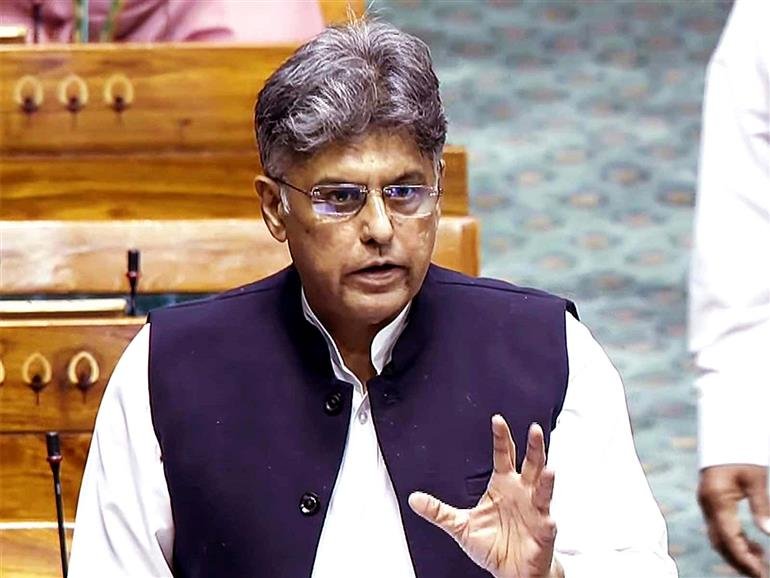 New Delhi : Congress MP Manish Tewari on Monday gave notice to move a motion for adjournment of the House business in the Lok Sabha to discuss the need for a new Anti-Defection Law. In his notice, Tewari proposed suspension of the listed business of the day to hold a discussion on framing the contours of a new law to prevent mass political defections.
He said the proposed law should address defections driven by opportunism and without genuine ideological or policy differences, while also ensuring space for honest and critical dissent within and outside Parliament and legislatures.
“I move that this House do suspend Question Hour, Zero Hour and all other listed business of the day to discuss the contours of a new Anti-Defection Law that proscribes Mass Political Defections driven by opportunism and bereft of any genuine ideological or policy differences while simultaneously providing space for honest and critical dissent both inside and outside Parliament and the legislatures,” the notice reads.
The Tenth Schedule, also known as the anti-defection law, was added to the Constitution through the 52nd Constitutional Amendment Act in 1985. It provides for the disqualification of lawmakers who switch parties or defect. The law applies to members of Parliament and state legislatures under Articles 102(2) and 191(2) of the Constitution.
Additionally, Dravida Munnetra Kazhagam (DMK) MP Tiruchi Siva has given a notice under Rule 267 in the Rajya Sabha, seeking suspension of listed business to discuss issues related to the Cauvery river dispute. In his notice, the MP sought a discussion on the “non-implementation of the Cauvery Water Regulation Committee (CWRC) award by the Karnataka government” and the proposed construction of a reservoir at Mekedatu across the Cauvery River. Siva stated that the move has affected the livelihood of farmers in Tamil Nadu and called for the constitution of a tribunal to resolve the Mekedatu issue.
“To discuss the non-implementation of the CWRC award by the Karnataka govt and the further attempt to construct a reservoir at Mekedatu across the Cauvery River, which has resulted in drastically affected the livelihood of the Tamil Nadu farmers and the need to constitute a tribunal with regard to resolve the Mekedatu issue,” the notice reads.
The Cauvery water dispute is a long-running inter-state river water-sharing conflict with Karnataka and Tamil Nadu being the principal parties. The dispute revolves around how the waters of the Cauvery River should be shared, particularly during years of low rainfall.
The issue resurfaced amid developments concerning the Mekedatu balancing reservoir project, proposed by Karnataka. It has been a major point of friction between the two states, with Tamil Nadu traditionally opposing it on the grounds that it would affect the flow of water downstream.


Comments are closed.