
Keeping an unconscious body alive through machines appears less like living and…..
...... more like Prolonged Torment.
Our Community Health Advisor, *Dr Naresh Purohit, (Advisor – National Mental Health Program), endorses the recent decision of Apex Court favouring use of passive euthanasia for providing ultimate relief to patients suffering from terminal diseases
New Delhi/Bhopal: Modern medical science has developed the ability to arti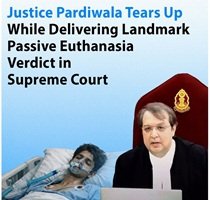 ficially prolong life but has failed to resolve the ethical question of whether sustaining life at all costs is truly humane when life itself becomes nothing more than pain, unconsciousness and a meaningless biological process. In terminal cancer, severe neurological disorders, deadly traumatic injuries and end-stage illnesses, life often becomes synonymous with suffering. Keeping an unconscious body alive through machines appears less like living and more like prolonged torment .
The debate in India over allowing someone to die dates to the 2011 case of Aruna Shanbaug, a nurse who spent 42 years in a vegetative state following a brutal sexual assault.
The Supreme Court of India then rejected a plea by Shanbaug’s family to end her life, and she died from pneumonia in 2015 aged 66.
But the court has issued a landmark verdict on 11 March, 2026 recognising passive euthanasia under strict safeguards and with judicial approval. The Supreme Court of India has allowed the withdrawal of life support for 32- year- old Harish Rana who has been in an irreversible permanent vegetative state for the past 13 years after falling from a building.
Across the country, thousands of such cases silently endure suffering, with neither solutions nor a clear legal  pathway. This situation is not just a medical crisis; it is a profound test of human sensitivity and social justice.
Individuals should have the right to make decisions about the final chapter of their lives, as self – determination is a core value of a democratic society.
Indian law has yet to provide a clear and compassionate framework. Many believe that when dignity, awareness, and hope disappear from life, a dignified death becomes more meaningful than the mere continuation of existence.
This raises a fundamental question as to why does our legal system still view such a death through the lens of suspicion, fear, and criminality? Sections 309 and 306 of the Indian Penal Code have long remained legal obstacles to voluntary euthanasia. Although the Mental Healthcare Act of 2017 partially decriminalised attempted suicide by recognising it as a consequence of mental distress, there is still no comprehensive and explicit law addressing euthanasia.
Article 21 of the Constitution guarantees the right to life and personal liberty, yet the debate continues as to whether this right also includes the right to a dignified death.
International experience shows that where well-defined legislation and multi-layered oversight mechanisms exist, the scope for misuse is minimal.
Countries such as the Netherlands, Belgium, Canada, and Switzerland have demonstrated that compassion and regulation can coexist.
The time has come for India to shed its hesitation and enact a clear, compassionate law on euthanasia. Such a law must scientifically define incurable and irreversible conditions, place the patient’s will and dignity on the highest pedestal, spare families unnecessary suffering, and provide doctors with ethical and legal protection.
Euthanasia is not an act against life; it is a compassionate response against meaningless suffering. When life is reduced to a mechanical biological process sustained only by machines, devoid of consciousness, dignity, and hope, death should be seen not as a crime but as a human right.
**Dr. Narresh Purohit-MD, DNB, DIH, MHA, MRCP(UK), is an Epidemiologist,  and Advisor-National Communicable Disease Control Program of Govt. of India, Madhya Pradesh and several state Health organizations. He’s the Principle Investigator – Association of Studies In Behavioural Science), Dr. Purohit is also Advisor-National Mental Health Program .
