
Japan, South Korea on high alert after North Korea fires multiple missiles; PM Takaichi vows “complete preparedness”
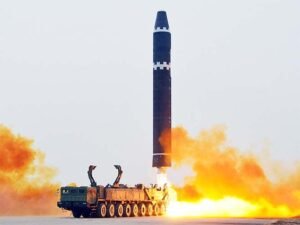 Tokyo : Japan remained on high alert on Sunday morning following the launch of what appeared to be multiple ballistic missiles from North Korea. The Japanese government activated its top-tier crisis management protocols to ensure public safety and regional stability in the face of the renewed provocation. Confirming the development, Prime Minister Sanae Takaichi provided details on the early morning escalation. In a post on X, she stated, “At around 06:00 today, what may be multiple ballistic missiles were launched from North Korea.”
Highlighting the current trajectory and the subsequent international response, the Prime Minister noted, “The items that may be ballistic missiles are believed to have already fallen outside Japan’s EEZ, and at present, Japan, the United States, and South Korea are closely coordinating to analyse information.”
In immediate response to the perceived threat, the Japanese administration mobilised its security apparatus to mitigate potential risks to maritime and aerial traffic. PM Takaichi detailed the swift internal measures taken by the executive branch to address the unfolding situation, ensuring a comprehensive government-wide reaction.
“As the government, immediately after the launch, we convened the emergency response team at the Crisis Management Center in the Prime Minister’s Office to collect information, while I instructed relevant ministries and agencies to devote all efforts to information gathering and analysis,” the Japanese Prime Minister added.
She emphasised that the priority of the administration is “to provide prompt and accurate information to the public, to thoroughly confirm the safety of aircraft, vessels, and the like, and to maintain a state of utmost readiness in preparation for any contingencies.”
The incident underscores the ongoing tensions in the region and the Japanese government’s stance on national security under the current leadership. Takaichi reaffirmed the administration’s commitment to security, noting that “the Hiyoshi Cabinet regards crisis management as the essence of national governance, and we intend to ensure complete preparedness for all crisis management matters, including cases such as this.”
Adding further context to the scale of the threat, Al Jazeera reported that this incident marked North Korea’s “seventh ballistic missile launch” of the year and its fourth such test in April alone.
The missiles were launched from the eastern coastal city of Sinpo at approximately 6:10 am local time (21:10 GMT on Saturday), according to a statement from South Korea’s military cited by Al Jazeera. In a parallel defensive move, Seoul has heightened its surveillance measures and is maintaining close coordination with both the United States and Japan.
Amid these escalating tensions, South Korea’s presidential office convened an emergency security meeting, as media reports indicated growing concern over Pyongyang’s relentless weapons activity. These launches stand in direct “violation of United Nations Security Council resolutions” that prohibit North Korea’s missile programme.
Al Jazeera reported that Pyongyang has consistently rejected these restrictions, however, arguing that they “infringe upon its sovereign right to self-defence.”
The timing of these tests is particularly significant, occurring ahead of a planned summit in mid-May between Chinese President Xi Jinping and US President Donald Trump, where North Korea is expected to be a primary focus.
This diplomatic friction is compounded by technical warnings. Earlier this week, IAEA head Rafael Grossi cautioned that the North has made “very serious” progress in its nuclear capabilities, including the likely “addition of a new uranium enrichment facility.”
This assessment follows recent rhetoric from North Korean leader Kim Jong Un, who reiterated last month that his country’s position as a nuclear-armed “state” is irreversible. He stressed that expanding a “self-defensive nuclear deterrent” remains critical for national security, a stance that continues to test the resolve of the international community.


Comments are closed.