
Israeli Army Chief “commanding” strikes on Iran, says military
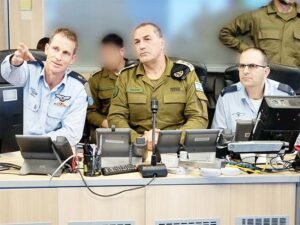 Tel Aviv : Amid intensifying military engagements in West Asia, the top leadership of the Israel Defence Forces (IDF) has been actively directing military operations against Iran from their central operational command hub.
In a post on social media platform X, the Israeli Air Force stated, “The Chief of the General Staff, Lieutenant General Eyal Zamir, the Commander of the Air Force, Major General Omer Tishler, and senior IDF officials have en conducting ongoing situational assessments and commanding IDF strikes in Iran from the Air Force Operations Center over the past hours.”
The high-level military briefings come at a critical juncture as aerial multi-city engagements break out across major Iranian hubs, including Tehran, Isfahan, and Tabriz.
The joint command structure highlights Israel’s top brass directly monitoring and executing the operational strategy in real-time.
Reiterating their strategic posture and readiness to expand countermeasures if provoked, the Israeli Air Force further emphasised that the military is fully prepared to handle escalating multi-front threats.
“The IDF is on high alert and ready to continue operations across all sectors against anyone who threatens the State of Israel,” the post added.
These targeted operations triggered thunderous detonations across multiple Iranian metropolitan hubs, including the capital city, shaking areas in close proximity to Mehrabad International Airport.
The heavy cross-border engagement erupted despite recent public assertions from US President Donald Trump, who claimed he “calls all the shots” in the regional theatre and indicated he had explicitly directed Israeli Prime Minister Benjamin Netanyahu to abstain from military retaliation.
This sudden kinetic friction represents the initial direct military confrontation between the two state actors since the implementation of a ceasefire on April 8, effectively shattering weeks of relative calm.
The immediate trigger for the confrontation was a heavy exchange of strikes over the weekend, which began when Israel carried out aerial operations in the Beirut area on Sunday.
Those strikes marked the first such attacks since Washington internalised a framework for a new Lebanese truce plan last week.
In direct response to the operations in Beirut, Tehran executed a retaliatory wave of 11 ballistic projectiles directed at municipal sectors in northern Israel, setting off emergency air-raid sirens across the area.
Following that initial salvo, the Israel Defence Forces launched their early Monday morning counter-strike inside Iranian territory, which Iran’s Revolutionary Guards confirmed involved the use of air-launched ballistic missiles.
The sharp deterioration in regional security has sent immediate shockwaves through global energy markets, forcing oil prices to climb by more than USD 2 per barrel.
Renewed hostilities subsequently drove global crude prices up by more than 3 per cent during early financial trading on Monday, pushing benchmark Brent futures back above USD 96 a barrel.
The compounding violence has severely complicated intensive diplomatic mediation managed by Washington, which aims to secure an agreement to end the wider war.


Comments are closed.