
Iran war frustration boils over as Trump, Hegseth clash over missile stockpile concerns; White House calls it “fake news”
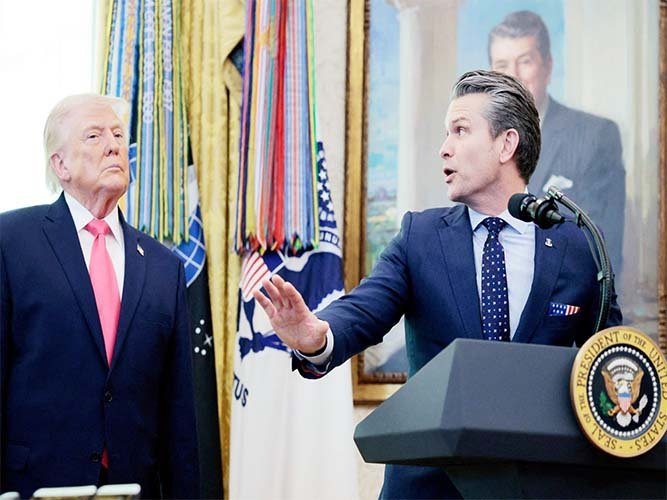 Washington DC : Tensions over US military stockpiles amid its conflict with Iran have reportedly escalated at Camp David last week, where President Donald Trump confronted his War Secretary Pete Hegseth over concerns about severe munitions shortages that could limit Washington’s future military options over the Islamic Republic, according to a report by The Washington Post.
According to The Washington Post, Trump’s frustration over the Iran conflict intensified during a Cabinet meeting at Camp David on Friday, where he questioned Hegseth over why he believed he had not been fully informed about shortages of key weapons systems.
Two people familiar with the matter told The Washington Post that Trump confronted Hegseth over what he viewed as “extreme munitions shortages” and expressed frustration that he believed the issue had already been addressed.
The reported exchange centred on shortages of long-range guided missiles and air-defence interceptors, which officials said have influenced decisions on whether to conduct additional large-scale strikes against Iran.
Earlier, Trump had called of “the biggest attack since World War II” on Iran, citing possible negotiations over the Strait of Hormuz.
The White House, however, has rejected the claims, calling the report “fake news”.
White House Press Secretary Karoline Leavitt denied that any such confrontation took place, saying she was present at Camp David with Trump and Hegseth and that the account was inaccurate.
“I was at Camp David with President Trump and Secretary Hegseth. This literally never happened, and we told the Washington Post that repeatedly. This B.S. story was shopped to many outlets by someone clearly out to disparage the Secretary, for whatever reason. Unfortunately for them, the President loves the Secretary and thinks he’s doing a tremendous job. FAKE NEWS!” Leavitt said in a post on X.
Pentagon spokesman Sean Parnell also called out the report.
“We told the Washington Post the same thing. They ran with the fake, anonymously sourced BS anyway. Complete & total Fake News,” he stated in a post on X.
The Washington Post reported that weapons shortages come as the US military has expanded operations in West Asia. The US has used significant quantities of cruise missiles, air defence interceptors and tactical ballistic missiles during the conflict. The depletion of some missile stockpiles has also raised concerns about the ability to support allies, including Ukraine, which continues to face Russian long-range attacks and requires air-defence systems from Western partners.
A US official cited by The Washington Post said shortages of interceptor missiles have affected decisions over when and where to use defensive weapons, with assessments based on factors including the target of incoming threats and their potential impact.
The report further claimed that during the Camp David discussion, Hegseth defended his position and attributed responsibility for the shortage issue to Deputy Defence Secretary Stephen Feinberg, alleging that Trump had not been fully briefed on the situation.
The Pentagon rejected these claims. Parnell said Hegseth had not misled Trump and denied reports of internal disagreements over military stockpiles or Iran strategy.
“Secretary Hegseth did not mislead anyone about our munitions posture, and he did not blame Deputy Secretary Feinberg. These claims about depleted stockpiles, internal disagreements, the Secretary’s position on Iran … are equally fictional,” Parnell stated, as quoted by The Washington Post.
The reported disagreement comes as Hegseth has faced questions over the costs and risks of the Iran war.
During a Senate hearing in July, he faced criticism from Democrats over whether the administration had been provided accurate assessments of the conflict, including the impact of prolonged operations on US military inventories.
Hegseth defended the administration’s position, blaming previous defence policies under the Biden administration for existing shortages rather than current military operations.
The Department of War has sought additional funding from lawmakers to replenish weapons stockpiles.
Hegseth, Deputy Secretary Feinberg and Joint Chiefs Chairman General Dan Caine have requested USD 67 billion in additional military funding, with Hegseth describing the request as an “urgent, necessary” effort to restore depleted inventories.
The administration’s proposed defence budget of USD 1.5 trillion for the next fiscal year includes record spending and significant funding for missile production, but the package faces political hurdles in the US Congress.
Military stockpile concerns predate the Iran conflict, with officials warning before the war that the US lacked sufficient reserves for a prolonged campaign. However, the scale and pace of weapons use during the conflict have intensified concerns over shortages of both offensive and defensive systems.


Comments are closed.