
Indus Water Treaty to remain in abeyance till Pak ends terror support, Pak efforts to play victim not working: Sources
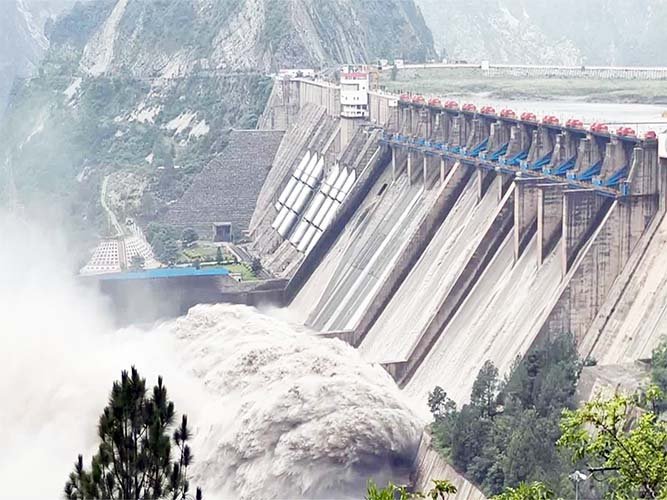 New Delhi : The Indus Waters Treaty (IWT) can no longer function in its present form and will remain in abeyance until Pakistan “credibly and irrevocably” ends its support for cross-border terrorism, with any reconsideration of the 1960 pact possible only thereafter as part of a renegotiation process, sources told news agency.
According to sources, Pakistan’s attempt to play victim in order to galvanise support for its stand is not working. Recently, the Pakistani side even sought the support of the Canadia Foreign minister during his Pakistan visit to raise this issue.
Sources say any potential dispute on the water treaty has to be approached in a staggered manner. First there needs to be talks at the Government to Government level, then an approach to neutral observers and finally an approach to the Court of arbitration. Pakistan has thus violated the treaty terms by seeking to approach the court directly and thus India is not bound to act.
Sources say Pakistan’s attempt to play victim are not working. There has been no bar on the Pakistani side as far as the building of water storages or dams on their side are concerned. However, there has been no effort to do so and now Pakistan is seeking to pin the blame on India which smacks of double standards.
Sources say Pakistan has been complaining about any activity from India on the eastern rivers which fall under India’s jurisdiction. Sources says no one has bought the Pakistan line that it is India that has violated treaty provisions.
Sources further say Pakistan was asked to reassess the provisions of the treaty in 2023 but Pakistan did not agree to do so. According to sources, the treaty no longer reflects present-day realities, with India’s population, developmental requirements, climate challenges and engineering capabilities having changed significantly over the past six decades.
“The Treaty was based on the engineering techniques of the 1950s. Since then, India’s population demographics, need to generate clean energy, water demand for irrigation and drinking water, climate change challenges and technological capabilities have changed fundamentally,” the sources said.
Sources say these factors were presented to the Pakistan side but they refused to discuss the same and India has since put the water treaty in abeyance.
Sources further contend that Pakistan repeatedly misused the treaty’s dispute-resolution mechanisms to delay Indian hydropower projects by escalating technical issues to international forums and pursuing parallel proceedings before the Neutral Expert and the Court of Arbitration.
It also reiterates India’s long-held position that the Court of Arbitration was “illegally constituted” and that its proceedings, awards and decisions are “null and void” without legal effect. Sources say that Pakistan’s attempts to use the illegal mechanism has been laughed out at the international stage.
Sources further said the decision to keep the treaty in abeyance stems from the Cabinet Committee on Security’s (CCS) decision of April 23, 2025, following the brutal terror attack in Jammu and Kashmir’s Pahalgam, killing 26 innocent people, and asserted that the conditions under which the treaty was negotiated have fundamentally changed.
“The Treaty will remain in abeyance until Pakistan credibly and irrevocably abjures its support for cross-border terrorism. This is the threshold condition. The question of reconsideration or renegotiation would arise only after this condition is fulfilled,” sources said.
Sources argue that the treaty, signed in 1960, “cannot function” under the present circumstances as the spirit of goodwill and peaceful coexistence on which it was negotiated has been eroded by Pakistan’s continued support for cross-border terrorism and its repeated objections to India’s hydropower projects.
“The Treaty was negotiated in an atmosphere of goodwill and peaceful coexistence. Pakistan’s sustained support for cross-border terrorism has fundamentally undermined the conditions necessary for its continued implementation,” sources added.
With the treaty in abeyance, the sources said all institutional mechanisms under the agreement, including meetings of the Permanent Indus Commission, inspections and routine exchange of hydrological and project-related data, remain inoperative.
However, the sources noted that India will continue to issue flood warnings to Pakistan on humanitarian grounds. It states that India voluntarily issued 23 flood warnings during the last flood season outside the treaty framework and is likely to continue doing so to safeguard human life and property.
The sources also outlined an accelerated push for hydropower development in the Chenab basin, identifying projects such as the 1,856 MW Sawalkote Hydroelectric Project, the 1,000 MW Pakal Dul Project, the 850 MW Ratle Project, the 624 MW Kiru Project and the 540 MW Kwar Project as priorities.
It further states that India will undertake systematic sediment flushing and reservoir management at projects including Salal and Baglihar to restore storage capacity, improve dam safety and enhance hydropower efficiency, describing such measures as internationally accepted engineering practices rather than attempts to alter downstream river flows.
The sources also maintained that Pakistan’s water challenges stem primarily from domestic mismanagement, including inadequate storage, ageing irrigation infrastructure and inefficient water use, rather than upstream development in India.


Comments are closed.