
India at UNSC says “world’s focus on Strait of Hormuz” must not divert attention from Gaza
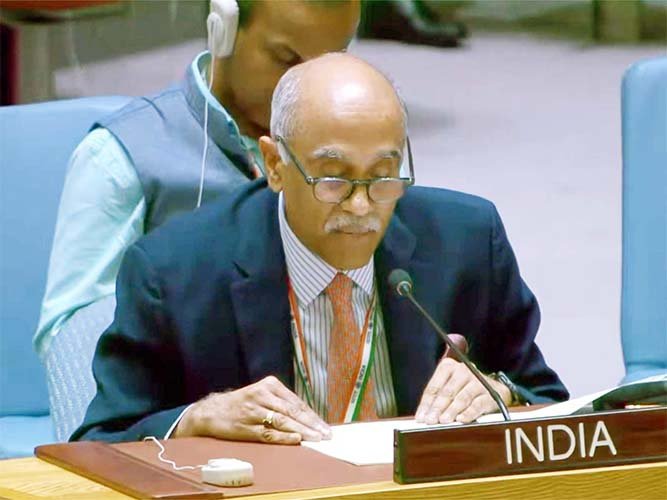 New York : India on Tuesday (local time) called for an immediate de-escalation of tensions in West Asia, condemned recent attacks on commercial vessels in the Strait of Hormuz, and urged the international community to not to lose sight of the humanitarian crisis in Gaza.
Addressing the United Nations Security Council’s Quarterly Open Debate on the Situation in the Middle East, India’s Permanent Representative to the UN, Ambassador Parvathaneni Harish, said the region remains of immense strategic importance to India due to its trade, energy and people-to-people ties.
“Middle East, which is West Asia, is a region of immense importance to India. Our stakes in the security and stability of the region are high. India’s trade and energy supply chains are strongly linked to this region. With bilateral annual trade of around USD 180 billion, cumulative Foreign Direct Investment of over USD 31 billion, and remittance of more than USD 52 billion from GCC alone, these linkages have direct implications for our economy and energy security. Around 10 million Indians live and work in the Gulf region. Their safety and well being are a key priority for us,” Harish said.
He noted that hostilities had resumed after a brief pause and called for urgent de-escalation. “After a brief pause in the ongoing conflict in the region, there has been a worrying resumption of attacks and escalation of hostilities. This is deeply concerning and India calls for an immediate de-escalation of tensions,” he said.
Harish strongly condemned the recent attacks on commercial vessels, including GFS Galaxy, MT Al Bahiyah and MT Mombasa, during their transit through the Strait of Hormuz. “Several Indian citizens were injured, including some seriously, one Indian tragically lost his life, and one is missing, in these attacks,” he said.
“India has consistently condemned acts of violence targeting seafarers and disrupting free and safe navigation through international waterways like the Strait of Hormuz. India strongly advocates a return to dialogue and diplomacy in the interests of peace, security and stability in the region,” he added.
“The targeting of commercial shipping and civilian infrastructure in the region must end, and free and unimpeded navigation and commerce through the international waterways in the region, in keeping with international law, must be restored at the earliest,” Harish said.
Highlighting the humanitarian situation in Gaza, Harish stressed that global attention on maritime security should not overshadow the plight of civilians in the Palestinian enclave.
“World’s focus on the Strait of Hormuz must not divert our attention away from the dire humanitarian crisis in the Gaza Strip. The loss of civilian lives and destruction of civilian infrastructure are pressing concerns that the international community must act on immediately, with a deep sense of urgency. We must continue to fully support the ongoing efforts through the full implementation of UNSC Resolutions, including UNSCR 2803,” he said.
Reaffirming India’s longstanding support for the Palestinian people, Harish said India’s development assistance to Palestine amounts to around USD 175 million through development projects, humanitarian assistance and contributions to the United Nations Relief and Works Agency for Palestine Refugees (UNRWA).
“India is firmly committed to efforts that make a tangible impact on the daily lives of the Palestinians. India’s development assistance to the cause amounts to around USD 175 million. This has taken various forms, ranging from development projects, humanitarian assistance and contributions to UNRWA, among others. India has been a top emerging donor of UNRWA and we have given operational flexibility to the UN Agency for utilizing our contributions. Earlier this month, at the Palestine donor group meeting in Brussels, India announced its commitment to the setting up of a specialty hospital, an artificial limb fitment centre and a vocational training institute for Palestine. India’s ongoing projects include the construction of the Palestinian Institute of Diplomacy,” he said.
Emphasising the need for a political solution, Harish reiterated India’s support for the two-state solution. “India’s long standing support for the two-state solution is well known. India believes that a sovereign, independent and viable State of Palestine living side by side in peace with Israel, within secure and recognized borders, is essential to a comprehensive and lasting solution,” he said.
On Lebanon, Harish stressed that UNIFIL peacekeepers “must never become targets” and said India strongly condemns all attacks against them, while also underlining the need to prepare for a post-UNIFIL scenario by strengthening the Lebanese Armed Forces.
“UNIFIL peacekeepers pursue UN Security Council mandates and therefore, must never become targets. They serve the cause of international peace and security. India has strongly condemned all attacks on UNIFIL peacekeepers. Their safety and security are a priority. The sanctity and inviolability of UN premises must be fully respected. Further, it is important to be ready for a post-UNIFIL scenario, and in this context, the Lebanese Armed Forces must receive requisite support and assistance,” he said.
On Syria, Harish reaffirmed India’s support for a Syrian-led and Syrian-owned political process. “On Syria, we stress the importance of a Syrian-led and Syrian-owned political process, in line with UNSC Resolution 2254. The principles of sovereignty, independence, unity and territorial integrity of the Syrian Arab Republic must remain central to all efforts. We also reiterate our support to ongoing efforts in finding long-term solutions,” he said.


Comments are closed.