
“India stands ready to work with ASEAN as reliable, equal partner”: Rajnath Singh
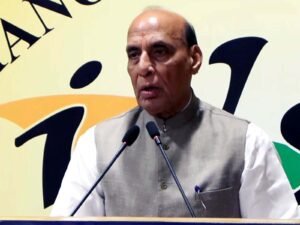 New Delhi : Defence Minister Rajnath Singh on Wednesday called for stronger defence cooperation between India and ASEAN countries, including joint research on maritime security, counter-drone systems, cyber defence and disaster response, stressing that regional challenges require collective action and practical solutions.
Addressing the Association of Southeast Asian Nations (ASEAN)-India Defence Think Tank Forum in the national capital, Singh said the forum should move beyond an exchange of views and help identify practical steps that governments and institutions could jointly implement.
“This forum grew out of my informal interaction with ASEAN defence ministers in Kuala Lumpur last year. I am pleased that this idea has now taken shape. I hope this meeting will do more than just exchange views. I hope it will help us identify practical steps that our governments and institutions can take together,” Singh added.
Highlighting the historical ties between India and Southeast Asia, the Defence Minister said their relationship was rooted in shared history, culture, trade and ideas, with maritime routes connecting their people for centuries.
“For centuries, our people have connected through maritime routes across the Bay of Bengal, exchanging goods, knowledge, art, and traditions,” he said.
He noted that the influence of Indian philosophical and spiritual traditions could be seen in the temples, monuments, languages and cultural practices of the region. Ancient Indian kingdoms, including the Cholas and Pallavas, had maintained links with Southeast Asia through trade and maritime contact, he added.
“Today, this civilizational bond provides a strong foundation for our modern partnership. As we work together for peace, stability, and prosperity in the Indo-Pacific, we draw strength from a history that reminds us that India and Southeast Asia have long been connected by the sea, by culture, and by the spirit of friendship. They are also a strong foundation of our future,” Singh said.
He said India and ASEAN shared an interest in peace, stability, prosperity and an open and inclusive Indo-Pacific, adding that ASEAN was central to India’s Indo-Pacific vision.
“India’s Act East Policy, SAGAR and MAHASAGAR vision advocate open, multipolar cooperation, and we align these approaches through ASEAN-led mechanisms,” he said, describing the Act East Policy as a long-term commitment to working with Southeast Asia as an equal partner.
Referring to the changing regional security environment, Singh said strategic competition was growing and actions at sea were sometimes creating pressure and uncertainty.
He also identified terrorism, cybercrime, piracy, trafficking, illegal fishing, climate-related disasters and risks to vital supply chains as challenges that crossed national borders. “These challenges are often borderless. No country can address all of them alone,” he said.
The Defence Minister also stressed that countries should build trust, respect each other’s sovereignty, follow international law and keep channels of dialogue open. “Differences should be discussed early and peacefully before they become disputes. And we should support the regional order in which countries can work together without being forced to choose sides,” he said.
He said India attached great importance to ASEAN-led platforms such as the ASEAN Defence Ministers’ Meeting-Plus (ADMM-Plus), adding that India’s approach and ASEAN’s outlook on the Indo-Pacific could complement each other.
“We should strengthen cooperation, not create competition between regional forums,” he said.
On maritime security, Singh said the Indian Ocean and the waters of Southeast Asia formed a connected maritime space through which trade, energy, people and essential goods moved. “The seas do not separate us. They connect us,” he said, adding that keeping these waters safe was a shared responsibility.
He identified maritime domain awareness, interoperability and cooperation in underwater awareness as key areas for ensuring a stable, rules-based maritime order.
Singh said the designation of 2026 as the ASEAN-India Year of Maritime Cooperation provided an opportunity to translate shared interests into practical action. “We should improve the sharing of maritime information, strengthen cooperation among our navies and coast guards, and build the ability to respond together to emergencies,” he said.
He also called for cooperation against piracy, trafficking, illegal fishing and other threats in accordance with international law.
Encouraging experts at the forum to identify achievable measures, Singh proposed regular exchanges between maritime information centres, greater professional interaction among naval and coast guard personnel, and practical exercises focused on search and rescue, disaster relief and the protection of critical maritime infrastructure.
He also called for examining gaps in underwater awareness and the ability to respond to activities that fall below the threshold of open conflict.
The Defence Minister said cooperation should also prepare countries to deal with natural disasters, including cyclones, floods, rising sea levels and extreme weather, which could damage ports, disrupt trade and threaten lives and livelihoods.
“Humanitarian assistance and disaster relief should therefore be a regular part of our defence dialogue. We can learn from one another, share best practices and improve coordination before a crisis occurs,” he said.
On defence technology, Singh said artificial intelligence, drones, cyber capabilities and space-based systems were becoming increasingly important in how countries protected themselves. “Recent conflicts have also shown that relatively low-cost drones can challenge much more expensive defence systems. We need to respond with practical, affordable and adaptable solutions,” he said.
He stressed that innovation should not remain limited to large organisations, adding that startups, universities, research institutions and smaller companies could also contribute to defence capabilities.
Singh cited India’s Innovations for Defence Excellence (iDEX) initiative and the Technology Development Fund as mechanisms that had created opportunities to collaborate with innovators on defence requirements.
He invited think tanks to explore collaboration between Indian and ASEAN innovators on clearly defined challenges, including counter-drone systems, cyber defence, maritime surveillance and disaster response.
“We should consider joint research projects, shared testing opportunities, exchanges among young researchers, and carefully designed innovation challenges,” he said.
He added that such cooperation should protect sensitive information, respect intellectual property rights and ensure the responsible sharing of technology. “The aim should be to develop useful capabilities while strengthening trust between our countries,” Singh said.

