
Today’s Motto: ‘Tears are words, spoken by the heart’
As Every Day makes a new beginning in life, it brings new opportunities, opens new avenues, to perform and make a mark, to write a Page in History Book !
This is Your Day-TODAY: Take a Determined Step Forward and Make History !
On this day, 07 Oct….
1520 – First public burning of books in the Netherlands, in Louvain, 07 Oct. Book burning has a long history. Books were the ta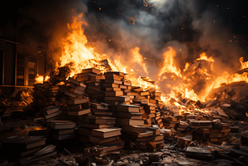 rgets because they ‘are the embodiment of ideas, and if you hold extreme beliefs you cannot tolerate anything that contradicts those beliefs or is in competition with them’. Book burnings are mainly symbolic. When you destroy a book you a
 re destroying your enemy and your enemy’s beliefs).
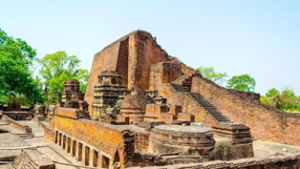
Turkish invader Bakhtiar Khilji’s army is belived to have destroyed a big Buddhist library in Nalanda Vishwa Vidyapeeth (Univsersity) in Magadha Kingdom (now in Bihar) in 1193. The Library is believed to have been established by Gupta king Kumaragupta-I in 1200 BCE, as a major centre of learning and had over 5,000 Sanskrit books where 10,000 students from China, Arabia, Europe came to study. It has now been restored by PM Modi led NDA Govt.
1586 – The Mughal army entered Srinagar where ‘Khutbah’ was being recited i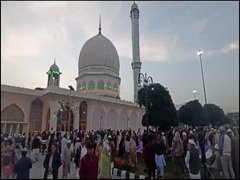 n the name of the Emperor.
1714 – People riot due to beer tax in the Netherlands.
1806 – Carbon paper patented in London by inventor Ralph Wedgewood. (In 1801 Pellegrino Turri, an Italian inventor, invented carbon paper to provide the ink for his mechanical typing machine, one of the first typewriters. Carbon paper {originally carbonic paper} was originally paper coated on one side w ith a layer of a loosely bound dry ink or pigmented coating, bound with wax. The advent of word-processing and the decline of typewriting meant that any number of copies of a document could be printed on demand, and the decline of carbon paper, which had already been partially superseded by photocopying and carbonless copy paper, became irrevocable).
1856 – Cyrus Chambers Jr patents folding machine that folds book & newspapers.
1900 – The term “orienteering” is first used for an event. (Orienteering is a family of sports that requires navigational skills using a map and compass to navigate from point to point in diverse and usually unfamiliar terrain, and normally moving at speed. Originally a training exercise in land navigation for military officers, orienteering has de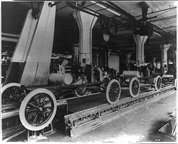 veloped many variations. Among these, the oldest and the most popular is foot orienteering).
1913 – Henry Ford institutes the moving assembly line for assembling vehicles (pic credit-Library of Congress Prints and Photographs).
1919 – Mahatma Gandhi and Jawaharlal Nehru began the publication of newspaper, ‘Navjeevan’. It was later taken over by Associate Journals Ltd., publishing National Herald and Qaumi Awaz.
1931 – First infrared photograph, Rochester, New York.
1950 – Mother Teresa founded the Missionaries of Charity in Kolkata.
1952 – Chandigarh became the capital of Punjab. Known as City Beautiful and the Garden City was planned and 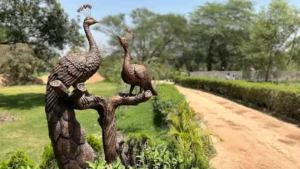 constructed under the French archtect Le Corbusier.
1992 – The Rapid Action Force in India to deal sympathetically and expertly with communal riots. This force also helps the civil administration in dealing with natural calamities.
1997 – Indian Central government women employees to get 135 days’ maternity leave and men to get 15 days’ paternity leave.
1999 – Long jumper Sanjay Kumar Rai became the first Indian man to go over the eight-metre twice when he leapt to a personal best 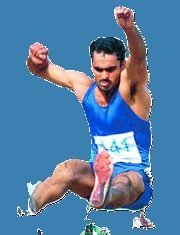 of 8.02m at the National Athletic Circuit meet in Mumbai and sound a fresh threat to T. C. Yohannan’s two-decade old national record of 8.07m. The current record is 8.09 m set by Prem Kumar during the Railway championships in Aug 2013).
Born…. 1891 – Narhari Parikh. A Gujarati freedom fighter, author, social reformer was one of the freedom fighters and a close associate of Mahatma Gandhi. He con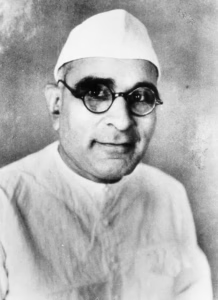 trolled all of Gandhi’s institutions from Bardoli near Surat (pic credit-theprint.in).
1914 – Begum Akhtar (Akhtari Bai), famous ghazal and thumri singer. Also known as Mallika-e-Ghazal. She was born in Faizabad, Uttar Pradesh.She was master of Ghazal. Dadra, Thumri in Hindustani Classical sangeet. She sang for All India Radio and for many films. She was honoured with Padma Bhushan and Sangeet Natak Akademy award in 1972.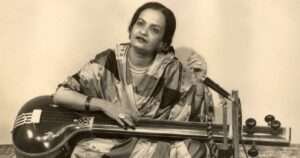
RIP…. 1708 – Guru Gobind Singh, the tenth and last Guru of the Sikhs. He was a great warrior, poet, philospher became 10th Guru at te age of 9 years, after his father Guru Teg Bahadur was executed by mughal emperor Aurangzeb in Delhi in 1675.He guided Sikhs for 33 years, until his death in 1708 by stabbing by Mughal soldiers. Guru Gobind Singh ordered that there will not be any living human as Guru, the holy Granth Sahib should be followed as living Guru of his disciples after him. He also selecte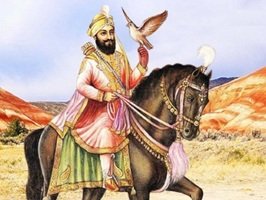 d Panj Piaras from a public convention (Sangat) to guide his followers. He also established Khalsa Panth to protect ladies, poor and weaker followers from Mughal tyranny. The 10 Sikh Gurus preached love, brotherhood and protected majority Hindus and their followers for over 240 years from Guru Nanak Dev ji (1469) to Guru Gobind Singh ji (1708).
You may have known…. A 2023 survey found that 1 in 2 Indians agree it’s important to live together before marriage to understand their partner better (called Live-in), whil e another noted over 80% of millennials think they are still considered a taboo (pic credit-blog.shadi.com). {Compiled by Lt. Gen. (R) Raj Kadyan}

