
Shredded tents, destroyed jet: Images reveal hidden scale of Iranian strikes on US Gulf bases
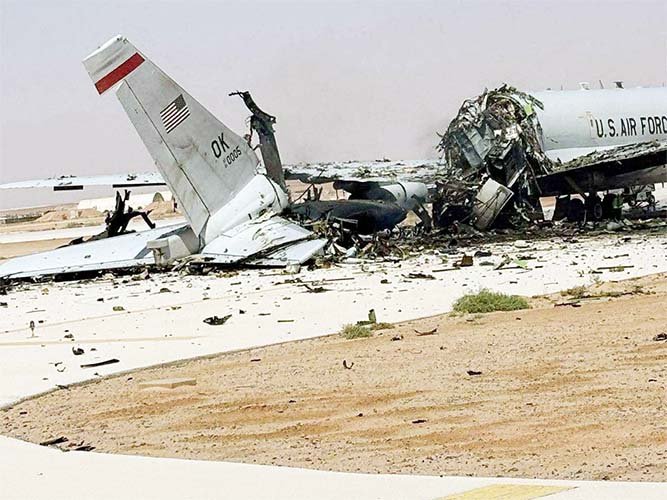 Washington DC : Photographic evidence depicting a destroyed aircraft, tattered tents, and heavily compromised military trailers has provided an unprecedented look at the consequences of Iranian missile and drone strikes targeting United States military installations throughout the Middle East, according to CBS News.
The visual documentation, captured at an American installation situated in Saudi Arabia alongside two separate facilities located in Kuwait, was supplied to CBS News by active-duty United States service members who requested anonymity owing to strict military communications policies.
Characterising the severity of the infrastructure destruction, one American service member told CBS News that much of the devastation had been withheld from public view, stating, “We’re standing there with our eyes closed getting punched in the face.”
The same service member added, “This is major damage to our bases that hasn’t been communicated to the American public.”
The emergence of these images coincides with the release of a Pentagon inspector general’s assessment outlining the extent of structural losses sustained by United States forces amid the ongoing hostilities.
According to the official report published the previous week, United States Central Command confirmed that Iranian missile barrages inflicted structural damage upon or entirely demolished hundreds of individual buildings and related facilities across American installations located in Kuwait, Bahrain, Qatar, the United Arab Emirates, Saudi Arabia, Iraq, Oman, and Jordan, as reported by CBS News.
Furthermore, the document verified that dozens of United States military aircraft were either heavily impacted or completely destroyed during the exchanges.
The Pentagon’s inspector general estimated that the military campaign, designated Operation Epic Fury, accumulated a financial expenditure totalling USD 33.4 billion between February 28 and June 30. Out of this total outlay, approximately USD 22.3 billion was directed exclusively towards munitions procurement and utilisation.
The fiscal computation reportedly excludes expenses associated with restoring compromised base infrastructure, indicating that the cumulative economic cost will escalate further.
In addition to financial expenditures, the federal watchdog verified that the United States armed forces are confronting growing deficits in specific ordnance inventories following the prolonged campaign, contradicting repeated assertions by US President Donald Trump maintaining that American weapons stockpiles remain robust.
The Department of War indicated that initiatives are underway to accelerate acquisition timelines and manufacturing output while simultaneously replenishing critical raw materials, specialised components, and selected tactical munitions.
Nevertheless, the inspector general cautioned that expanding domestic industrial manufacturing capacity to meet wartime demands will require substantial time.
While President Trump has consistently asserted that the nation possesses “virtually unlimited” ammunition supplies while dismissing apprehensions regarding depleted reserves, the inspector general’s findings underscore the severe operational strain inflicted upon military supply chains after months of continuous combat operations.
The United States and Israel initiated military actions against Iran on February 28, with President Trump stating that the offensive was designed to prevent Tehran from acquiring nuclear capabilities, an ambition repeatedly denied by Iranian authorities.
In retaliation, Tehran launched retaliatory strikes directed at American military assets deployed throughout the region, impacting installations positioned across multiple Gulf states and surrounding territories.
Concurrently, Iranian forces moved to restrict navigation through the Strait of Hormuz, a vital maritime energy corridor handling roughly one-fifth of global petroleum shipments.
The resulting logistical disruption drove international crude oil quotations upward while intensifying broader anxieties regarding the wider conflict’s destabilising effect on the global economy.

